My grandfather was the quintessential engineer. He was also a professor, and his daily wardrobe - without fail - consisted of a white dress shirt, sporting a pocket protector, and a pocket full of writing implements. I've followed in his footsteps so far as pursuing the engineering profession, and I regularly carry a pen or two in my shirt pocket, but I've never gone so far as to get myself a pocket protector. Today gave me pause when this happened:
I've been a practicing engineer for 11 years now, and it's safe to say that for every day I've gone to work wearing a shirt with a pocket I've had a pen in that pocket. So that's at least 2,200 opportunities for a catastrophe like this to happen. I guess I should feel fortunate that I've come so far without a mishap. And I do.
But why couldn't I have been wearing a shirt that I don't like? Maybe it's time to follow in grandpa's other footsteps.
Wednesday, April 25, 2012
Saturday, April 21, 2012
The Ninjas
I love these lyrics:
The ninjas are deadly and silent
They're also unspeakably violent
The speak Japanese, they do whatever they please
And sometimes they vacation in IrelandIf you haven't heard Barenaked Ladies sing this song then do yourself a favor and click here.
Wednesday, April 11, 2012
Asparagus Fries
Tonight was leftover night. By happy accident we stumbled upon a new treat: Asparagus Fries!
This was the creative process:
Voila! Asparagus Fries! They're crispy, with a nutty flavor, and yet they're asparagus too. Super tasty.
Bon Appetit!
This was the creative process:
- Wash asparagus
- Break off root end
- Lay in single layer on baking sheet
- Bake 15 minutes at 350 degrees
- Enjoy some portion of asparagus
- Put remaining portion in refrigerator for 3 days
- Remove asparagus from refrigerator
- Lay in single layer on baking sheet
- Bake 10 minutes at 350 degrees
Voila! Asparagus Fries! They're crispy, with a nutty flavor, and yet they're asparagus too. Super tasty.
Bon Appetit!
Tuesday, April 10, 2012
Dear Facebook
To whom it may concern,
I understand, based on yesterday's news of your acquisition of Instagram, that you are in desperate need of a new VP of Merger's and Acquisitions over there. Clearly somebody is allowing you to pay way too much for your newly acquired businesses, and I'd be glad to step in and put a stop to this nonsense.
Let's have a look at what you overpaid for Instagram. By the numbers:
Here's what I'd offer:
For a total savings of: $322.5M!
You're welcome. But before you let the old VP go, please have him set my new salary.
Sincerely,
David Sevy
Aspiring Facebook Executive
I understand, based on yesterday's news of your acquisition of Instagram, that you are in desperate need of a new VP of Merger's and Acquisitions over there. Clearly somebody is allowing you to pay way too much for your newly acquired businesses, and I'd be glad to step in and put a stop to this nonsense.
Let's have a look at what you overpaid for Instagram. By the numbers:
- 1 office
- 12 employees
- 30 million members
Here's what I'd offer:
- $500,000 for capital assets
- $500,000 per employee (roughly four times their average annual salary, I'm guessing)
- 12 x $500,000 = $6,000,000
- $671,000,000 for the members
- This assumes advertising revenue of $0.15 per week for 20% of the members over 20 years, accounting for inflation
For a total savings of: $322.5M!
You're welcome. But before you let the old VP go, please have him set my new salary.
Sincerely,
David Sevy
Aspiring Facebook Executive
Monday, April 9, 2012
Daylight Savings
We're now a few weeks past daylight savings, although my VCR (purchased in 2000) thinks it was a more recent event. I manually reset the time when we "sprang forward" on March 11th. Over the past weekend it re-adjusted itself, so that it's now an hour ahead of where it's supposed to be. Thanks technology!
I hear a lot about daylight savings every time it rolls around. Around our house there is no love lost on having to roll the clocks forward and backward, or throwing off the kids' schedules. Fortunately springtime is not the worse of the two time changes, since it effectively gets the kids to wake up later. Fall is the real problem, when all of the sudden the early risers are up way too early.
I've heard the whole phenomenon attributed to Ben Franklin, although this year I read that he didn't actually advocate a changing of clocks. His idea was more along the lines of ringing church bells to get people up earlier when the sun rose earlier. That sort of communal, forced wake up is probably not ideal either, but more and more I look at Arizona (which doesn't observe DST, for those not in the know) and I think they may actually be on to something.
In this day and age it's difficult to believe that time-shifting is really doing much to save energy. It's definitely no longer necessary to rise early to get all your work done for the day, unless you're actually a farmer. For the rest of us we have the miracle of electric lighting, which I'm sure most of us use throughout the day regardless of the sun's position outside.
Consider the power consumed in your home, and I think you'll find that the energy going into lighting is a fraction of the total consumption. Appliances run all hours of the day, and don't get less use because the clocks change. Heating and cooling systems run according to timers and thermostats. There may be some efficiency from having higher or lower settings in "off" (sleeping) hours, but not much. Comparatively, lights are a miniscule power draw.
It's time for a change! The next candidate for state legislature that runs on a platform of Daylight Wastings will definitely be getting my vote.
Thursday, April 5, 2012
Lego Fallingwater
The Lego Architecture series has intrigued me since it first appeared, and this past Christmas I received a set of my own. I thought it'd be fun to document the build process brick-by-brick. A YouTube search revealed that my idea was not original by any means (over 50 similar videos!) but I still thought it'd be fun. I've been wanting to try some stop motion with my older Sony digital camera anyway, and this seemed like as good a subject as any.
I built a camera stand from Legos, lacking a small enough tripod for the height at which I planned to shoot. The whole setup was simple, and admittedly crude, and I would make a few changes if I were to repeat this process. For one, the camera stand needed to be slightly more rigid, as evidenced by the slight jitter between frames. For another, although the Sony image quality looks good it requires two AA batteries to run and this film went through two sets of batteries. In the future I'll be getting an HD webcam if I decide to produce another similar film.
Although the stop-motion build-up was fun, I really enjoyed adding the live waterfall to the scene. I used Blender with the Blam add-on for static camera matching. The whole matching process was very straightforward once I got the latest version of the add-on installed. (NOTE: when upgrading an add-on from an older to a newer version it's necessary to remove the old version, install the new version, AND restart Blender.)
I don't think I got the Lego geometry, for channeling the fluid simulation, exactly right. It looks pretty good in most spots. The 3D view of the geometry is shown below. I tried to constrain the flow as it left the Lego creek bed. This worked for the first part of the simulation, but eventually it overflowed and ran out the sides.
To overcome this "leakage" problem I ended up creating a mask and compositing the Fallingwater image over the top of the fluid simulation sections that I wanted to hide. I know where the masking is happening, and it doesn't look particularly obvious to me. Hopefully that's true for the casual viewer as well.
I built a camera stand from Legos, lacking a small enough tripod for the height at which I planned to shoot. The whole setup was simple, and admittedly crude, and I would make a few changes if I were to repeat this process. For one, the camera stand needed to be slightly more rigid, as evidenced by the slight jitter between frames. For another, although the Sony image quality looks good it requires two AA batteries to run and this film went through two sets of batteries. In the future I'll be getting an HD webcam if I decide to produce another similar film.
| The "Studio" Setup |
Although the stop-motion build-up was fun, I really enjoyed adding the live waterfall to the scene. I used Blender with the Blam add-on for static camera matching. The whole matching process was very straightforward once I got the latest version of the add-on installed. (NOTE: when upgrading an add-on from an older to a newer version it's necessary to remove the old version, install the new version, AND restart Blender.)
I don't think I got the Lego geometry, for channeling the fluid simulation, exactly right. It looks pretty good in most spots. The 3D view of the geometry is shown below. I tried to constrain the flow as it left the Lego creek bed. This worked for the first part of the simulation, but eventually it overflowed and ran out the sides.
![]() |
| 3D geometry matching the Lego creek bed (roughly) |
To overcome this "leakage" problem I ended up creating a mask and compositing the Fallingwater image over the top of the fluid simulation sections that I wanted to hide. I know where the masking is happening, and it doesn't look particularly obvious to me. Hopefully that's true for the casual viewer as well.
![]() |
| This was the node setup used to combine the two shots and mask the overflow. |
Tuesday, April 3, 2012
Vanity, In Plate Form
I do not get why people find it worthwhile to put personalized plates on their car. Even so, I do enjoy checking them out when I'm on the road. It's fun to try to decode them, usually. Occasionally you come across one that doesn't make any sense - I wonder about the people who pick plates that aren't understood by their apparent audience, namely me. I mean, not just me, but if you're picking something to show to the general public, of which I am definitely a member, shouldn't they be able to understand it?
This wouldn't be such a big deal to me if it weren't for the fact that people are paying money for these things. It's a relatively trivial amount, I suppose, but even so it seems like money wasted. I mention all this because today I found another type of personalized plate that I find as bad as those that are incomprehensible. In this case, however, the plate was the exact opposite of being hard to understand.
During my morning commute I found myself behind a car that looked something like this:
As the caption indicates, this is a Volkswagen GLI. And in the case of the car I saw this morning, it was sporting this personalized license plate:
This wouldn't be such a big deal to me if it weren't for the fact that people are paying money for these things. It's a relatively trivial amount, I suppose, but even so it seems like money wasted. I mention all this because today I found another type of personalized plate that I find as bad as those that are incomprehensible. In this case, however, the plate was the exact opposite of being hard to understand.
During my morning commute I found myself behind a car that looked something like this:
![]() |
| The Volkswagen GLI |
As the caption indicates, this is a Volkswagen GLI. And in the case of the car I saw this morning, it was sporting this personalized license plate:
VWGLI
What?!? I'm already driving right behind you, where the manufacturer has clearly marked the car's make and model with chrome logos and lettering. As seen in the photo, this is also true for anyone with a front-side view. So why would you possibly want to spend any amount of money to duplicate that information for anyone in the vicinity of your vehicle?
Maybe this driver took some misguided advice from the Utah Department of Motor Vehicles:
Hello? This does not tell me "why" to choose a personalized plate, just what to put on it! Somebody should have explained to this driver that the DMV is only out to get more of your money. You do not, in fact, have to take their advice.
I do not get it.
Thursday, March 29, 2012
Lego Taxonomy
I recently undertook, with my family, a project I actually scorned a few short years ago. Growing up I had many Lego sets, and standard practice was to:
Fast forward 25 years. I now have three avid Lego builders living with me (my three oldest), and they have jointly accumulated a respectable stockpile of bricks and sundries. A few years ago my wife suggested that we sort the Legos by some system into more manageable containers than the large storage container they all occupied. I told her that was a terrible idea, that I never needed such organization and I loved playing with my Legos.
Well it turns out I just hadn't reached critical Lego mass in my youth. I would attribute this mainly to the fact that I was just one boy collecting sets, the next younger boy being six years my junior, so he barely started getting into Legos as I was moving on to other interests. My three oldest, on the other hand, were all born in a span of three years. The end result of this birth spacing is that they have received, and pooled, many Lego sets over their lifetimes, and the sheer number of bricks makes them very hard to store in one container or to play with effectively. It's a lot of work to dig through a large, deep container for that one perfect piece to complete your model.
So, I ate my words, and two weeks ago we settled in for a three hour project with the whole family sorting Legos in the kitchen. I was not sure of the best approach at first, but we just dug in and I winged it as best I could as the whole family immediately started asking "Dad - where does this one go?"
We settled on division by color, grouping sufficiently similar colors into one container, with a few exceptions. The only false start we had was that light grey and dark grey soon outgrew their designated container, and so they were moved into their own individual buckets. We also ended up having to find some larger containers for certain colors. It was interesting to see what colors dominated by quantity. In my original Lego collection red far outweighed any other color, which I believe was due to the early generic builder sets I first received. I suppose if I'd had more space sets at that time (early 80's) I would have had more blue, or yellow had I had more castles, but that wasn't the case. These days, at least for us, it would seem that all the Star Wars sets have made their mark, as black, light grey, and dark grey all top the charts.
Here's what the project looked like, splayed out over the kitchen counter:
In the end we had 15 containers, broken out as follows:
- build each model as it was received
- play with it for a while
- break it down and add its component parts to the Lego bucket
Fast forward 25 years. I now have three avid Lego builders living with me (my three oldest), and they have jointly accumulated a respectable stockpile of bricks and sundries. A few years ago my wife suggested that we sort the Legos by some system into more manageable containers than the large storage container they all occupied. I told her that was a terrible idea, that I never needed such organization and I loved playing with my Legos.
Well it turns out I just hadn't reached critical Lego mass in my youth. I would attribute this mainly to the fact that I was just one boy collecting sets, the next younger boy being six years my junior, so he barely started getting into Legos as I was moving on to other interests. My three oldest, on the other hand, were all born in a span of three years. The end result of this birth spacing is that they have received, and pooled, many Lego sets over their lifetimes, and the sheer number of bricks makes them very hard to store in one container or to play with effectively. It's a lot of work to dig through a large, deep container for that one perfect piece to complete your model.
So, I ate my words, and two weeks ago we settled in for a three hour project with the whole family sorting Legos in the kitchen. I was not sure of the best approach at first, but we just dug in and I winged it as best I could as the whole family immediately started asking "Dad - where does this one go?"
We settled on division by color, grouping sufficiently similar colors into one container, with a few exceptions. The only false start we had was that light grey and dark grey soon outgrew their designated container, and so they were moved into their own individual buckets. We also ended up having to find some larger containers for certain colors. It was interesting to see what colors dominated by quantity. In my original Lego collection red far outweighed any other color, which I believe was due to the early generic builder sets I first received. I suppose if I'd had more space sets at that time (early 80's) I would have had more blue, or yellow had I had more castles, but that wasn't the case. These days, at least for us, it would seem that all the Star Wars sets have made their mark, as black, light grey, and dark grey all top the charts.
Here's what the project looked like, splayed out over the kitchen counter:
| Lego Sorting Is Fun! |
In the end we had 15 containers, broken out as follows:
- Black [Sweater-box size] (this is the most numerous color)
- White [Sweater-box size]
- Light Grey [Sweater-box size]
- Dark Grey [Sweater-box size]
- Red [Sweater-box size] (includes regular, pink, and dark shades)
- Green [Gallon size] (includes regular, light, and dark shades)
- Yellow [Gallon size] (includes regular and gold)
- Brown [Gallon size] (includes brown, orange-brown, and tan)
- Orange [Gallon size]
- Blue [Gallon size] (includes blue, light, dark, and purple shades)
- Odd / Transparent [Gallon size] (includes transparent, chrome, and speckled)
- Doors and Windows [Gallon size] (includes frames, doors, sashes, and shudders)
- Mini-Figures and Accessories [Gallon size]
- Wheels and Axels [Gallon size]
- Technic [Gallon size] (gears, struts, rods, etc.)
Wednesday, March 28, 2012
Livin' In The Cloud
The "cloud" is so over-hyped. I'm not a big fan of doing things "in the cloud". I'll take a local application over a thin client any day.
But putting data on-line is another matter. How I love being able to drop my data in one spot and access it from anywhere with an Internet connection. So cool. I'm too cheap to pay for any sort of remote storage, but I've put a few good free alternatives to use.
The first was the Amazon Cloud Player. This came about as a necessary way to get music onto the Kindle Fire. The uploader works well, and the upload process took about two days. You get 5 GB free, and I think I filled about 4 GB with my on-line collection. It's not my whole collection, but a reasonable chunk of it for use on the Fire. One cool feature was that tracks purchased from Amazon didn't have to be uploaded - they were automatically recognized and linked to the Cloud Player without any user input.
More recently, Google kicked-off their Play service. The free music storage is much more generous on Play - up to 20,000 songs, each as big as 250 MB. Sweet. Google's uploader worked well too, and now my whole music collection is on-line and accessible everywhere.
I'm also in the process of taking advantage of Google's PicasaWeb albums to back up my photo collection. This is no small collection, and backing it up is no small task. Fortunately, the Picasa application is handling most of the work, but I did have to do a little bit of up-front prep to take advantage of their free storage.
PicasaWeb gives you 1 GB of free storage. This is pretty much useless for storing any significant number of photos. However, if you resize everything so that the image size is 2048x2048 (or less) then you can store those images for free! Picasa will even do this resizing for you as it uploads, if requested.
The one limitation on this system is that uploaded photos go into an album, and albums are limited to 1,000 pictures. There's no limit on the number of albums you can have. Before I started uploading I split my photos into folders with 1,000 pictures or less, and currently I'm only about 4 folders (4,000 images) away from having everything on-line! This will be about a 12-day upload when I'm done, but it could have been completed faster. I've turned on a "Conserve Bandwidth" option in Picasa to throttle the upload so I don't affect other applications on the network.
I recognize that you get what you pay for with these kinds of services. Although I like having data backed up "off site", I have no expectation that this data is 100% safe just because I've put it on-line. I received no guarantee from Amazon or Google, and I realize that, which is why I have three different hard drives with all of my pictures here at home, and all of my CD's are still around if I need to go back to my original music. Even so, it's nice to have everything conveniently available via the web, and even if it's not a guaranteed backup I still consider it another line of defense against the unthinkable: Total Data Loss.
Tuesday, March 27, 2012
Rush to the Middle!
I really like the way Rick Santorum's campaign doesn't let a silly thing like logic get in the way of running for office. I am getting a little sick of his argument that he should be the Republican nominee because he's the most conservative. Then in the same breath he declares how important it is to get Obama out of office. In all the primary exit polling the Republican voters have agreed with him: whoever the Republican nominee is will get their vote because they want Obama out.
So how does it make sense to pick the most conservative nominee? Santorum says that Romney won't be able to differentiate himself from Obama, and will therefore lose the general election. On the contrary, Senator, Romney's moderate placement makes him an ideal challenger to put up against Obama in November. Consider how these two possible scenarios will play out:
- Santorum somehow gets the nomination. He steps up as Obama's challenger. Republicans side with Santorum. Democrats side with Obama. The swing vote is up for grabs. People who swung towards Obama four years ago may be a bit dissatisfied with him, but they picked him four years ago and they'll probably be inclined to give him a bit more time (four more years' worth). After all, he convinced them to vote for him four years ago, so he'll probably do it again. Obama for the win.
- Romney gets the nomination, as everyone is already expecting. He continues his well organized, well funded campaign on into the general election. Republicans rally behind Romney, as planned. Democrats side with Obama. Suddenly the swing voters have a real choice to make. No longer do they have to worry that a vote for Santorum is a vote for a crazy conservative that they can't identify with. Now they've got moderate Romney to consider. The swing vote now gets split, and with an alternative to Obama who swing voters can actually see from where they stand on the political spectrum (unlike Santorum, off in the right wing) they give Romney a chance and Obama finishes as a one-term president.
Friday, March 23, 2012
The Toddler Strikes Back
Creating my "Human Cloning Works" video was highly educational for me. I learned a lot of new stuff about Blender's compositor and rotoscoping. I wanted to keep that trend going, so I found another post-production challenge: light sabers. I admit that these kinds of videos are a dime a dozen on YouTube. I doubt any other subject matter could be as cliche for aspiring amateur effects artists. Probably because they're not too hard to do, and they can be fun to watch.
I knew how to mask out the saber blades from previous experience, but I wasn't sure how to get the saber effect. I experimented a little, but nothing looked like what I wanted. Eventually Google turned up an example for me that I tweaked a bit to arrive at this node setup:
The mask is on the left, and gets split into three different blur nodes. The Fast Gaussian gives you the larger aura, with the other two lesser blurs completing the inner glow of the blade (in two layers). The color curves can be adjusted to whatever blade color you want. This whole thing is then overlaid on the original footage with an AlphaOver node.
I made four masks in all. One for each blade, one for any foreground body parts that needed to obscure the blades during the fight, and one for the wall that blocks part of the view towards the end. The overlay order went like this:
I noted on the cloning post that I did the audio mix in Audacity, and a helpful poster at BlenderArtists informed me that the Video Sequence Editor could have been used. I decided to give it a shot this time. I still feel pretty uninformed about the ins-and-outs of the VSE, but I did figure out how to cross-fade a few segments, and control segment clipping and fade-in/out effects for both audio and video clips. Here's my final strip setup:
The VSE was really indispensable for doing the audio looping on this clip. I originally envisioned figuring out the time codes where I wanted all of the saber sound effects, and then putting it all together in Audacity. That would have taken a long time, and the results would definitely have been sub-par. Using the VSE I could drop the effects right on the time line, in multiple tracks, and check the sync in real time. It was so simple to tweak and adjust the timing. I'm definitely a believer in the VSE, even if I still have a lot to learn.
So, with no further ado, here is the finished product:
And now, for my next trick, I think it's time to try a little motion tracking. We'll see how that goes.
I knew how to mask out the saber blades from previous experience, but I wasn't sure how to get the saber effect. I experimented a little, but nothing looked like what I wanted. Eventually Google turned up an example for me that I tweaked a bit to arrive at this node setup:
The mask is on the left, and gets split into three different blur nodes. The Fast Gaussian gives you the larger aura, with the other two lesser blurs completing the inner glow of the blade (in two layers). The color curves can be adjusted to whatever blade color you want. This whole thing is then overlaid on the original footage with an AlphaOver node.
I made four masks in all. One for each blade, one for any foreground body parts that needed to obscure the blades during the fight, and one for the wall that blocks part of the view towards the end. The overlay order went like this:
- Original footage
- Blue blade
- Pink blade
- Wall mask
- Foreground mask
I noted on the cloning post that I did the audio mix in Audacity, and a helpful poster at BlenderArtists informed me that the Video Sequence Editor could have been used. I decided to give it a shot this time. I still feel pretty uninformed about the ins-and-outs of the VSE, but I did figure out how to cross-fade a few segments, and control segment clipping and fade-in/out effects for both audio and video clips. Here's my final strip setup:
The VSE was really indispensable for doing the audio looping on this clip. I originally envisioned figuring out the time codes where I wanted all of the saber sound effects, and then putting it all together in Audacity. That would have taken a long time, and the results would definitely have been sub-par. Using the VSE I could drop the effects right on the time line, in multiple tracks, and check the sync in real time. It was so simple to tweak and adjust the timing. I'm definitely a believer in the VSE, even if I still have a lot to learn.
So, with no further ado, here is the finished product:
And now, for my next trick, I think it's time to try a little motion tracking. We'll see how that goes.
Thursday, March 22, 2012
Happy Birthday Alan Bean!
A week ago today, on March 15th, Alan Bean celebrated his 80th birthday! Who is Alan Bean, you ask? I wondered that as well when the morning news mentioned him as one of the people celebrating a birthday last Thursday. It turns out Alan Bean was an astronaut in the 60's, and was the fourth man to walk on the moon. Kudos to him!
This revelation struck me as surprising that there are men still walking around our planet who have set foot on a completely separate celestial body, and I've never even heard of them! I consider the whole travel-to-another-planetoid thing quite impressive, and I agree with the morning news that the uniqueness of such an accomplishment really does make the men who accomplished it stand out as noteworthy.
This train of thought led me to another: are there men who visited the moon, but never actually got to walk on it? The whole Apollo 13 situation, in which they only got to circle the moon, was pretty unfortunate for those crew members. I wondered if many other astronauts found themselves in a similar situation. Google here I come!
A little reading on the Apollo program turned up these numbers:
On the other hand, just reading about the Apollo landings gives me a serious case of the heebie-jeebies. They traveled 238,855 miles from earth, through the vacuum of space, relying solely on 1960's technology? Talk about crazy! The accounts of the first landing (Apollo 11) include tales of computer malfunctions during the landing sequence, life support backpacks that didn't fit properly through the hatch, and the breaking of the main thruster switch almost stopping their return to Earth. It's a wonder any of them made it back alive.
So, honestly, if someone showed up at my door today and offered me a chance to visit the moon would I jump at the chance? Nope. I'm to chicken to even orbit the moon, let alone land on it. Good thing no one's relying on me to have the "right stuff".
This revelation struck me as surprising that there are men still walking around our planet who have set foot on a completely separate celestial body, and I've never even heard of them! I consider the whole travel-to-another-planetoid thing quite impressive, and I agree with the morning news that the uniqueness of such an accomplishment really does make the men who accomplished it stand out as noteworthy.
This train of thought led me to another: are there men who visited the moon, but never actually got to walk on it? The whole Apollo 13 situation, in which they only got to circle the moon, was pretty unfortunate for those crew members. I wondered if many other astronauts found themselves in a similar situation. Google here I come!
A little reading on the Apollo program turned up these numbers:
- 32 astronauts were selected to form the Apollo crew pool
- Of those 32, 24 actually flew to the moon
- Of those 24, 12 actually set foot on the moon
- Of those 12, 6 drove lunar rovers
On the other hand, just reading about the Apollo landings gives me a serious case of the heebie-jeebies. They traveled 238,855 miles from earth, through the vacuum of space, relying solely on 1960's technology? Talk about crazy! The accounts of the first landing (Apollo 11) include tales of computer malfunctions during the landing sequence, life support backpacks that didn't fit properly through the hatch, and the breaking of the main thruster switch almost stopping their return to Earth. It's a wonder any of them made it back alive.
So, honestly, if someone showed up at my door today and offered me a chance to visit the moon would I jump at the chance? Nope. I'm to chicken to even orbit the moon, let alone land on it. Good thing no one's relying on me to have the "right stuff".
Wednesday, March 21, 2012
Executive Orders
I find the Executive Order to be a very curious power of the U.S. presidency. Maybe that's just because I don't understand it thoroughly, but from what I gather the president can make any decree he wants. I suppose if a president did something the other branches of government objected to they must have some sort of recourse, but I don't know if that sort of response ever gets exercised. I'm pretty sure it hasn't in my lifetime. It seems like a governmental power that hearkens back to the time of emperors and kings.
The other day I had occasion to look up an Executive Order, and in the process I found that Google actually had some suggestions for me. I took that to mean that other people are also looking up these things, and I was curious what the "Top 10" Orders would be.
For your enlightenment, here are the top 9 (Google's suggestion list stopped at 9) in order of increasing popularity:
So what's your favorite Executive Order?
The other day I had occasion to look up an Executive Order, and in the process I found that Google actually had some suggestions for me. I took that to mean that other people are also looking up these things, and I was curious what the "Top 10" Orders would be.
For your enlightenment, here are the top 9 (Google's suggestion list stopped at 9) in order of increasing popularity:
- (Number 9) Executive Order 12015: Permitting students completing approved career-related work-study programs to be appointed to career or career conditional positions in the competitive service. [J.E. Carter, 10/26/1977]
- (Number 8) Executive Order 13575: Establishment of the White House Rural Council [B.H. Obama, 6/9/2011]
- (Number 7) Executive Order 9981: Establishing the President's Committee on Equality of Treatment and Opportunity In the Armed Forces [H.S. Truman, 7/26/1948]
- (Number 6) Executive Order 10998: Assigning emergency preparedness functions to the Secretary of Agriculture [J.F. Kennedy, 2/16/1962]
- (Number 5) Executive Order 9022: Partial Revocation of Executive Order No. 6957 of February 4, 1935, Withdrawing Certain Public Lands; Alaska [F.D. Roosevelt, 1/13/1942]
- (Number 4) Executive Order 11246: Equal Employment Opportunity [L.B. Johnson, 9/24/1965]
- (Number 3) Executive Order 11110: Amendment of Executive Order No. 10289 (which was "Providing for the performance of certain functions of the President by the Secretary of the Treasury") [J.F. Kennedy, 6/4/1963]
- (Number 2) Executive Order 8809: Good Conduct Medal [F.D. Roosevelt, 6/28/1941]
- (Number 1) Executive Order 9066: Authorizing the Secretary of War to Prescribe Military Areas [F.D. Roosevelt, 2/19/1942]
So what's your favorite Executive Order?
Thursday, March 15, 2012
Give It Up!
I've been waiting for the return of Mitt Romney since he dropped out of the 2008 primaries. I hoped he would be back, and he hasn't disappointed this time around. Last time it was no fun watching him lose at the polls. What a difference four years has made.
And yet, I find myself very frustrated even with all of Mitt's success. In the background are these noisy detractors who just won't go away. I'm looking at you, Gingrich and Santorum! I patiently waited while Perry, Bachmann, and Cain got the hint. (Seriously, Herman, you're thinking you should run for president with that chequered past of yours?) I breathed a sigh of relief when Palin announced she wouldn't be running. (The Republican name can only stand so much embarrassment. The country is not laughing with you, Sarah!) And I don't mind Ron Paul so much. Watching him pick up delegates is like watching two kids play "who can hit the softest". Good job Ron - you're going to be the only person in history to stay in the race to the end with so few delegates.
But, seriously, what is up with Gingrich and Santorum? Frankly, Gingrich is a bit of a joke too. And in a way I appreciate him splitting the vote and bringing Santorum down. But at the same time I get so annoyed to hear their campaigns talking about the importance of sticking out this race. Sticking out the race clear to the convention EVEN THOUGH EVERYONE KNOWS THEY CAN'T WIN! The foundation has been laid. The delegate tide is not possibly going to turn at this point, no matter how much support you guys can muster. Enough already!
I once observed that a trip to Las Vegas is essentially a tailor-made vacation for people who are really bad at math. So hey, Newt and Rick, if you need a break from the campaign trail I know just the place for you two to take some time off.
Thursday, March 8, 2012
Digital Photography - Saving Feelings Everywhere
The other day I found myself explaining the concept of film photography to my nine-year-old son. We received our first digital camera as a gift the day he was born, so his entire life has been spent sans film. The concept was totally foreign to him. "You had to get pictures from a store, and it took how many days?!?"
This caused me to reflect on the number of pictures we take thanks to the digital age. Growing up I went through 2 or 3 film cameras. My first was a Kodak Disc that I got when I turned 8. Through the years I probably went through only 1-2 discs, or rolls, of film per year. So over 14 years I'd estimate I took no more than 1,000 photos, probably far fewer.
We all know how great digital photography is. No need to extoll its virtues here. Even so, it's amazing to see what a difference a little convenience makes when you can take a virtually unlimited number of pictures, and there's no cost to "develop" them anymore. I think these numbers speak for themselves.
I think this chart has a couple of takeaways. One is that there's an unmistakeable growth trend here. Judging by that cumulative quantity, if I live another 40 years I will have taken over 126,000 photos by the time I die. Who needs that many pictures? Maybe it's time to reign in the old shutter finger.
Another takeaway is to consider the blessing of digital storage. Had I taken and developed every single one of these photos as a 4"x6" print, and stashed them in photo storage boxes, I'd be storing 24 boxes (12"x8"x5") full of prints. That's 6 2/3 cubic feet of space! No thanks - I'll stick with keeping my 70 GB of photos conveniently on my pocket-sized hard drive.
The most encouraging thing about these numbers is the per-capita counts over the years. When our second son came along my wife was deeply concerned with him getting as much attention, as many photos, as big of a scrapbook, etc. Equality was king. Conventional wisdom, and experience from our family lives growing up, suggests that parents have less time to focus on later children. At one time this translated to a deficiency of photos featuring younger children in the family.
Luckily for us, the digital age has overcome this parental failing. Here's the breakdown of the average number of photos per person over the years:
Even as the family has grown, each child's share of the family photo stash has not shrunk. Future crises of self esteem? Averted!
This caused me to reflect on the number of pictures we take thanks to the digital age. Growing up I went through 2 or 3 film cameras. My first was a Kodak Disc that I got when I turned 8. Through the years I probably went through only 1-2 discs, or rolls, of film per year. So over 14 years I'd estimate I took no more than 1,000 photos, probably far fewer.
![]() |
| The Awesome Kodak Disc |
We all know how great digital photography is. No need to extoll its virtues here. Even so, it's amazing to see what a difference a little convenience makes when you can take a virtually unlimited number of pictures, and there's no cost to "develop" them anymore. I think these numbers speak for themselves.
![]() |
| That's a lot of photos! |
I think this chart has a couple of takeaways. One is that there's an unmistakeable growth trend here. Judging by that cumulative quantity, if I live another 40 years I will have taken over 126,000 photos by the time I die. Who needs that many pictures? Maybe it's time to reign in the old shutter finger.
Another takeaway is to consider the blessing of digital storage. Had I taken and developed every single one of these photos as a 4"x6" print, and stashed them in photo storage boxes, I'd be storing 24 boxes (12"x8"x5") full of prints. That's 6 2/3 cubic feet of space! No thanks - I'll stick with keeping my 70 GB of photos conveniently on my pocket-sized hard drive.
The most encouraging thing about these numbers is the per-capita counts over the years. When our second son came along my wife was deeply concerned with him getting as much attention, as many photos, as big of a scrapbook, etc. Equality was king. Conventional wisdom, and experience from our family lives growing up, suggests that parents have less time to focus on later children. At one time this translated to a deficiency of photos featuring younger children in the family.
Luckily for us, the digital age has overcome this parental failing. Here's the breakdown of the average number of photos per person over the years:
- 3 family members = 550 photos / person
- 4 family members = 636 photos / person
- 5 family members = 707 photos / person
- 6 family members = 1,142 photos / person
- 7 family members = 1,710 photos / person
Even as the family has grown, each child's share of the family photo stash has not shrunk. Future crises of self esteem? Averted!
How To Succeed In Internet Business (Without Really Trying)
The Internet is a funny thing. It's so big and interconnected that it's easy to get caught up in the idea that you could do just about anything with it. 12 years ago I was going back to business school when the Internet boom was in full swing, and I had no doubt there must be something really cool I could do with the Internet to make money.
While in business school, in a marketing course, the teacher posed this question to the class: "What product are television networks selling?" A lot of answers were proffered. None of them were right, as I recall, and finally the professor had to clue us in. Television networks sell ... their viewers! Or, at least, a bit of their viewers attention. Hold onto that concept - we'll come back to it momentarily.
Of course, just my luck, long before I graduated (it was only a two year degree!) the boom went bust, and the economy in general went with it. When it came time to leave school not only was the Internet no longer a promising place to work, but just finding a job in any field was a challenge.
Fast forward to today.
The Internet is still with us, and it's going strong. There are some Internet-only endeavors that have taken off (Amazon, Netflix) emulating or replacing brick-and-mortar businesses (Walmart, Blockbuster) but I think most on-line business presences are an extension of a business built elsewhere. I may be oversimplifying things, but hopefully you get the gist.
Notably, two of the "giants" of the Internet are Google and Facebook. And what is the product these companies are selling? They're nothing more than the television networks of the digital age, bringing viewers to sit in front of a screen so that advertisers can connect with them. The sneaky thing about this new media is that instead of spending big bucks to create content people want to see (e.g. game shows, dramatic series, and the evening news) they rely on all of us to entertain each other. Sneaky though that may be, it also affords all of us an opportunity to profit from the enterprise. It's only fair.
So here I am, participating in the new media economy, having recently "monetized" my own little on-line media empire. I may get to cash in on the Internet after all, much to the satisfaction of my college-age self, but it turns out it's not going to replace my day job.
I'm only a month into this experiment, so these numbers have very little history behind them, but I thought I'd share them anyway. At the moment I am the proud "broadcaster" of 5 monetized YouTube videos and one general-interest blog. My oldest video has been on-line for about 18 months, and the total accumulated views of all five videos is currently 1,237.
According to Google AdSense, in February I had 58 hits on my videos, 9 of which clicked on ads, netting me $0.34 for the month. This month is only 8 days in, but so far I've had 17 views, 5 which included ad clicks, netting me another $0.12. If the trend for March holds I may be on track to make $0.46 this month, easily beating last month's record.
The good news: my view-to-click ratio has risen substantially (16% in February, 29% so far in March). The bad news: AdSense has a minimum payment policy of $100, so if the current trend stays flat I shouldn't expect to see any payouts for another 302 months.
I've got plenty of time to figure out how to spend my advertising earnings, since the check won't be arriving until May of 2037. I can hardly wait.
Thursday, March 1, 2012
What is up with these authors?
I enjoy reading the blogs of authors. I mean, they write for a living, so it makes sense that their blog would be a good read. Two blogs that I frequent regularly are those of Patrick Rothfuss (The Name of the Wind, The Wise Man's Fear) and Orson Scott Card (Ender's Game, etc.)
The other day I stumbled upon a new author web site belonging to Peter V. Brett, in particular I read this post. Brett has written two novels, The Warded Man, and The Desert Spear. Both excellent. I was looking for information on the third book in the trilogy when I found Peter's own update on the topic.
At first I was disappointed to learn that although book 3, The Daylight War, will be released in a year it is not - as betimes promised - the final book in the trilogy. The series is, in fact, a "cycle", and will run to five books. Brett explains the backstory as to how his cycle became marketed as a trilogy, but frankly I don't much care. Why stretch the story through five books, and cause readers to wait an extra four to six years, if the story can be wrapped up in a trilogy (according to Brett's own comments)? It seems a bit wasteful, of his talent and of my time.
Then something else about his post struck me, something I found rather odd. I don't mind if authors want to take their time writing fine books. Great. Hopefully we'll all enjoy them that much more when they're published. And they're art, right, so it's not like they can just be churned out on a schedule. But in his post Brett goes off on some tangent about how he promised his publisher he would meet certain dates, but they weren't really realistic, and now he's taking more time to complete his next novel. And here's his explanation as to why it's taking longer than expected:
But then there's his second point: he can't work because he wants to spend time with his daughter? I get it - I'm a dad, I love my kids, I wish I had more time with them, but is there really no way he can fit daddy time and author time all into a single day? In other words, do what pretty much the whole rest of the world does? Come on - how many people can just put off work indefinitely to hang out with their kids? I'm happy for him, I guess, but to hold this up as an excuse as to why he's not getting his work done just doesn't hold water with me.
But maybe I'm just jealous.
The other day I stumbled upon a new author web site belonging to Peter V. Brett, in particular I read this post. Brett has written two novels, The Warded Man, and The Desert Spear. Both excellent. I was looking for information on the third book in the trilogy when I found Peter's own update on the topic.
At first I was disappointed to learn that although book 3, The Daylight War, will be released in a year it is not - as betimes promised - the final book in the trilogy. The series is, in fact, a "cycle", and will run to five books. Brett explains the backstory as to how his cycle became marketed as a trilogy, but frankly I don't much care. Why stretch the story through five books, and cause readers to wait an extra four to six years, if the story can be wrapped up in a trilogy (according to Brett's own comments)? It seems a bit wasteful, of his talent and of my time.
Then something else about his post struck me, something I found rather odd. I don't mind if authors want to take their time writing fine books. Great. Hopefully we'll all enjoy them that much more when they're published. And they're art, right, so it's not like they can just be churned out on a schedule. But in his post Brett goes off on some tangent about how he promised his publisher he would meet certain dates, but they weren't really realistic, and now he's taking more time to complete his next novel. And here's his explanation as to why it's taking longer than expected:
Oh, I have my excuses. Early this year my part-time assistant (deservedly) went on to a full time publishing job, leaving me with a lot of administrative work that ate away at my writing time. Around the same time I also had major shoulder surgery that left my arm in a sling for months. I’m told it went well and I will be back to full strength without pain at some point, but six months out I’m still only at 75%, and prolonged or strenuous use leaves me in a lot of pain.What? He had shoulder surgery so he couldn't work? Isn't he a writer? Does shoulder surgery really preclude him from doing that work? Couldn't he work with just one arm, or dictate and have his writing typed up for later editing, or something? You need a little Brett background to really appreciate why he couldn't find a workaround for an arm in a sling. His first novel, 100,000 words, was written piecemeal during his daily commute to and from work by typing it into his cellphone. If he had the patience to do that there's no way he should be stopped by a little shoulder surgery.
And I spend a lot of time with my three year old daughter Cassie. I know I could put her in daycare or hire a sitter as many people do, but these years before she starts going to school all the time are precious, and I don’t want her to ever feel like daddy didn’t have time for her. We do arts and crafts and build marble runs and train sets. We practice her reading and watch Pixar movies. We argue about what she wants for dinner, bathtime and bedtime. And I wouldn’t trade it for anything.
But then there's his second point: he can't work because he wants to spend time with his daughter? I get it - I'm a dad, I love my kids, I wish I had more time with them, but is there really no way he can fit daddy time and author time all into a single day? In other words, do what pretty much the whole rest of the world does? Come on - how many people can just put off work indefinitely to hang out with their kids? I'm happy for him, I guess, but to hold this up as an excuse as to why he's not getting his work done just doesn't hold water with me.
But maybe I'm just jealous.
Tuesday, February 28, 2012
Cloning
After watching Tom Jelfs' "Blend That Film" tutorial:
... I decided to try out this technique myself. I was using Blender 2.61 at the time. Following Tom's instructions was pretty straightforward. I wanted to expand on his ideas and branch out a little bit, so instead of creating twins I went for triplets.
Here's the final compositor node layout:
The only real variation between what Tom did and my layout is that he only had one mask to deal with, which he put into a renderlayer which could be used directly in the compositor. I had three sets of overlaid footage, requiring two masks. I figured out how to put each mask on a different renderlayer, but only the active renderlayer was updated in the compositor. There may be a way to make this work correctly, but I didn't find one. My workaround was to render the masks out into two image sequences, and then feed the mask files back into the compositor. It worked great, but it did add an extra render step.
There were a couple of lessons learned in this process:
- The lighting between my three takes, even though they were filmed consecutively with minimal interruption, was different enough to be seen in the final composite footage. I attempted some manual color balancing to minimize the effect, but there was no way to do that effectively for the whole film. In the future, if I was really concerned about matching the shots, I would be more conscientious about controlling the lighting (i.e. no natural daylight).
- The leather couch in the shot changed its form enough between takes that it was noticeable in the final result. I would pay closer attention to the setting, and eliminate hard-to-control elements like leather upholstery if they might create inconsistencies between shots.
- I came across a handy application, the AoA Audio Extractor, when finishing the soundtrack. This software allowed me to pull the audio track off each of my three original clips. I then dropped each track into an Audacity project and created a single audio file to merge with the frame sequence output by Blender. The audio and video was combined using VirtualDubMod.
Wednesday, April 28, 2010
Shades of Grey

Shades of Grey, by Jasper Fforde, is a great read. I picked it up on a blog recommendation from Patrick Rothfuss with no prior knowledge about the plot or the author.
It turns out it's set in a far future utopia where everything is not as it seems. The mysteries of this world unfold with the story. It's at times both disturbing and very, very funny. Here's one of my favorite passages, the kind that found me laughing out loud as I read:
"And we have a ninety-thousand-piece jigsaw puzzle for rainy afternoons.""But someone lost the picture," grumbled Yewberry, "and there's a lot of sky."
"Challenging, we call that, Mr. Yewberry," remarked deMauve.
Tuesday, April 27, 2010
Take that, Plumbing!
I hate plumbing. The top three items on my "List of Things That I Hate" would have to be plumbing, chemistry, and thermodynamics. Which is why I'm feeling particularly accomplished tonight after having fixed a slow-running and dripping kitchen sink all in one go.
The drip problem first became apparent at least a month ago. I thought I'd ignore it at first, but of course it continued unabated for some time, slowly getting more persistent as the days went by. Eventually I resigned myself to the fact that Something would have to be done. I had long ago been shown how to fix a dripping two-handle faucet, but the one-handle variety (which needed the attention) was a mystery to me.
Some brief research revealed that the faucet, though two-and-a-half years old, was warranted to never drip. A quick call to the manufacturer was all it took to get a free replacement part in the mail. Before the nice customer service representative could get off the phone I asked, "Does this part come with instructions?" He responded that it would, indeed, and if I simply followed the included instructions all of my drip problems would be solved in a jiffy. My words, not his.
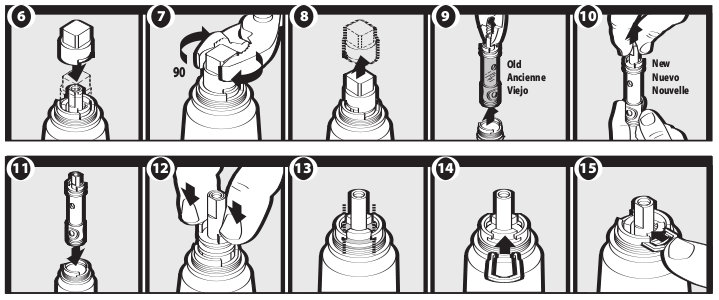
So I anxiously awaited the replacement part's arrival. When it came I was less than thrilled by the replacement directions:


Is this it? Am I in pre-school? Where are the words? Where are the detailed instructions?
Despite some misgivings I decided to press on with the replacement myself. After one false start for lack of a properly sized allen wrench (You're selling a set with 1/8 and 3/32, but no 7/64? ... Really?) I finally got underway tonight, and guess what! It was slow going, and there were moments of uncertainty along the way, but in the end it all came together and can definitely be called a success. My pessimistic vision of the kitchen sink becoming an unchecked geyser did not come to pass, and indeed everything is in better working order now than when the project began.
Booyah!
Subscribe to:
Posts (Atom)